
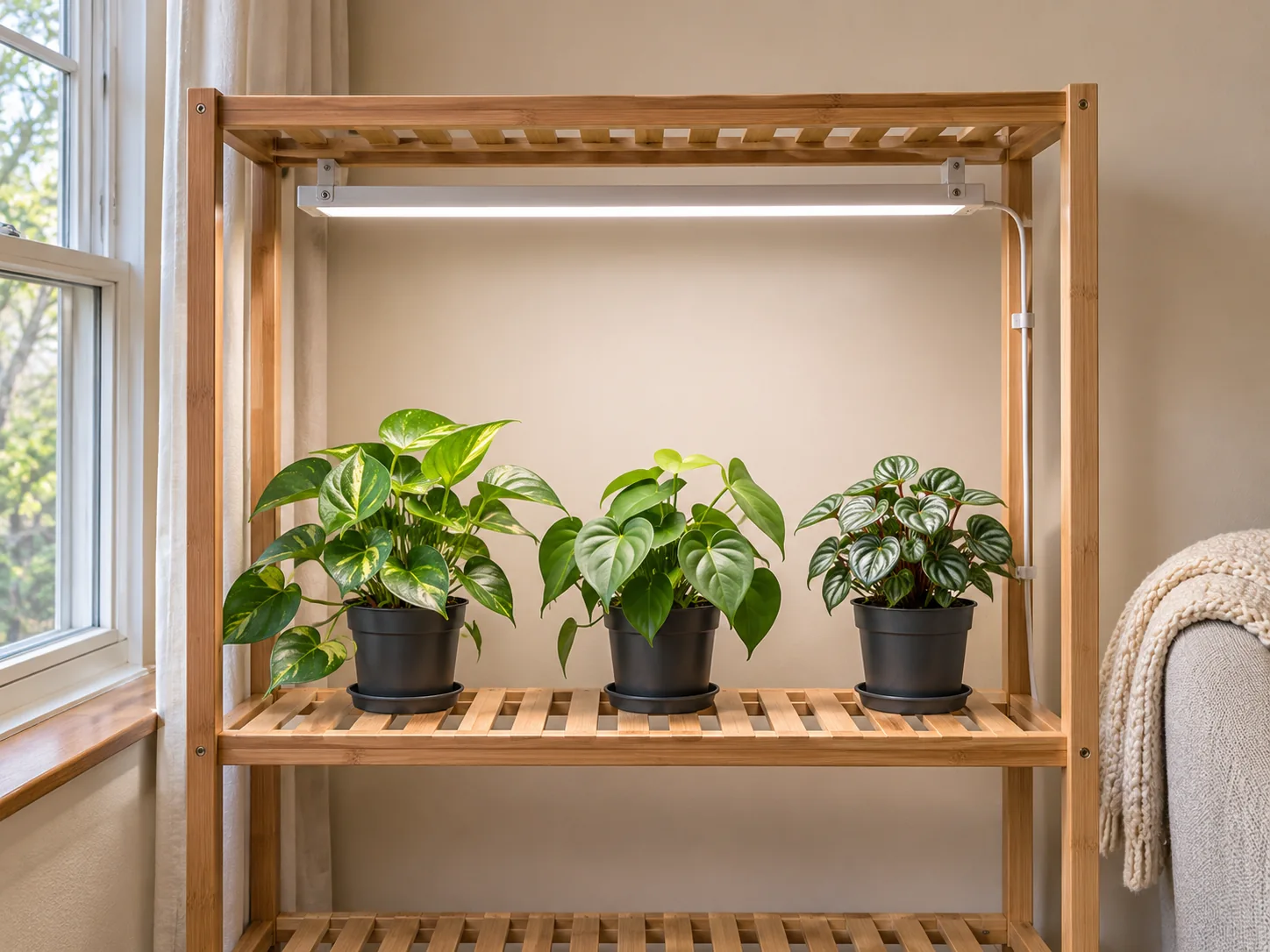
How far should a grow light be from a houseplant?
Use the fixture’s guidance for your type of plant, then check the light reaching the leaves. There is no correct distance for every lamp. About 30–60 cm (12–24 in) above the canopy is a commonly used reference range for foliage-houseplant setups, but a powerful panel and a small desk bulb can behave very differently at the same height.
For many foliage plants receiving some daylight, 12–14 hours on a daily timer is a useful starting schedule. Treat that as a trial, not a universal requirement. Species, natural light and the fixture’s output determine what is suitable. Flowering plants with specific day-length requirements need their own routine.
This guide is for ordinary indoor foliage plants in pots. A shelf of pothos or peperomia is a different lighting job from fruiting citrus, sun-loving succulents, seedlings or plants being prepared to flower. Decide what you want to grow before choosing the fixture.
Check the daylight before buying another lamp
Start with the actual growing position, not the brightness of the room as a whole. Observe where daylight reaches during the day, whether blinds stay closed, and whether an overhang, neighboring building or tree shades the window. A plant several steps back from a window can receive much less useful light than one near the glass.
The same month means different growing conditions around the world. A northern temperate home may need more supplemental light during its shorter days; a Southern Hemisphere home has a different seasonal pattern. Near the equator, a rainy season, building shade or an interior room may be more relevant than winter. Local daylight and placement are the useful starting points.
If a plant is declining, also check the pot. Light problems and root problems can overlap, and adding a lamp does not repair a waterlogged root system. Our guide to yellow leaves on houseplants explains what to inspect before making several changes at once.
Choose a fixture for the area it lights, not just the label
Look for a fixture that can illuminate the whole group at the intended mounting height. A linear bar may suit a narrow shelf; a spotlight may suit one plant. A broad panel above a few shade-tolerant plants can require careful adjustment. Match the illuminated footprint to your arrangement before comparing extra features.
A neutral-white horticultural LED can provide a useful spectrum without turning the room purple. A purple appearance is not proof of effectiveness, and the words full spectrum do not specify how much light reaches the plant. Standard household LEDs vary widely; some may support suitable plants when properly positioned, but a ceiling light across the room is not automatically adequate.
When available, compare the manufacturer’s light-distribution measurements at more than one height. PPFD describes the photosynthetically relevant photons reaching an area each second. A value measured directly under the center is not the value at the edge of the shelf. Electrical watts describe power use, not canopy illumination.
Without measurement data, be cautious about exact promises. A label showing high output is not a substitute for a mounting distance, coverage information and a realistic description of the intended plants. Lumens and phone readings can help compare positions under the same conditions, but they do not establish a precise plant-light prescription.
Mount the lamp above the canopy and make adjustment easy
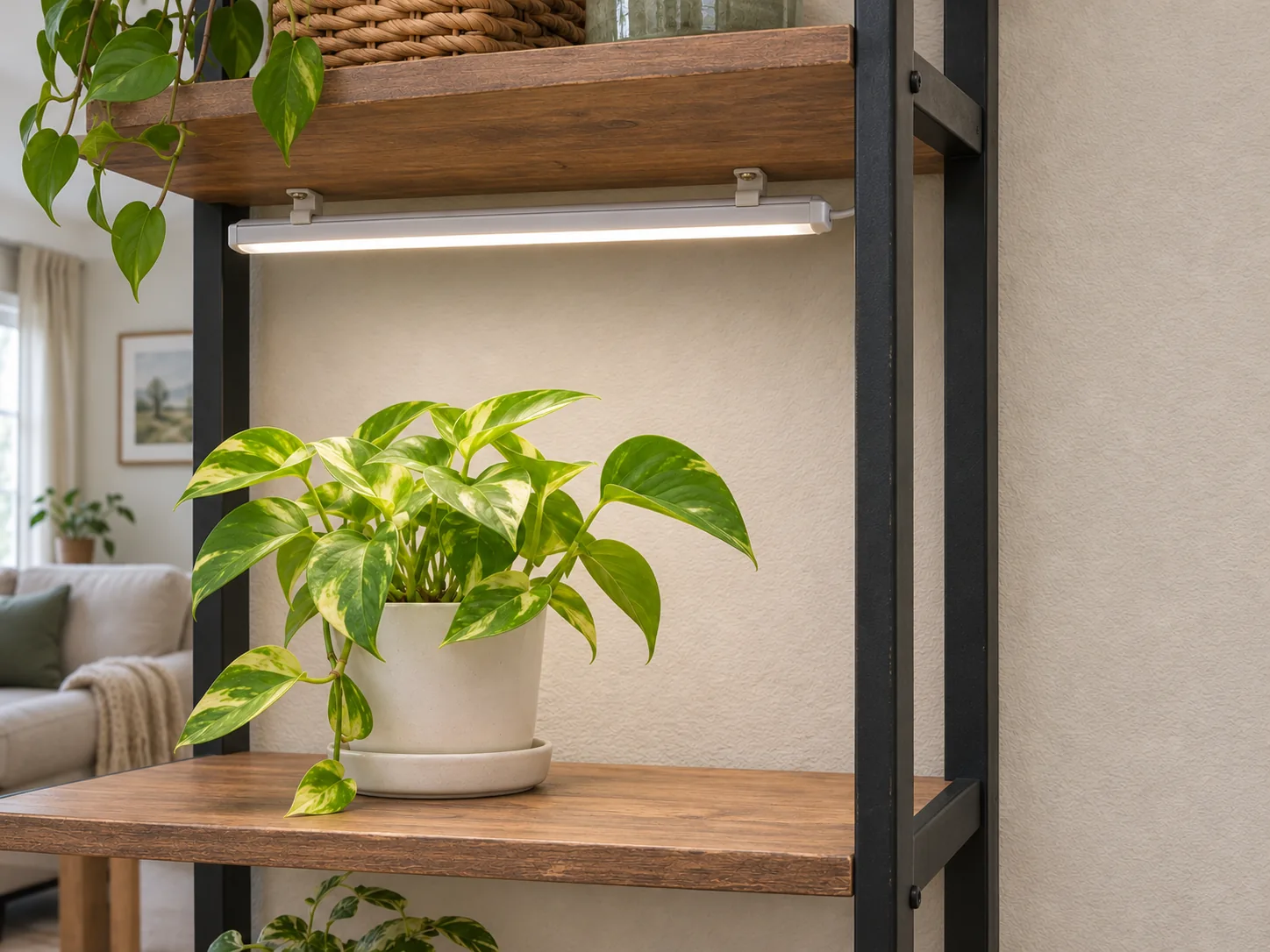
Place the light so that the foliage you want to grow is actually within its footprint. A lamp angled toward the pot or a decorative wall may leave the upper leaves poorly lit. Check the tallest and lowest plants separately; uneven canopy height can put one plant close to the lamp while another remains in shade.
Measure the gap from the light to the top leaves, not to the shelf surface. Use an adjustable position when possible so you can account for growth. As a plant becomes taller, its leaves approach the fixture even if nothing else in the setup moves.
Before switching on, secure the fixture as intended, keep watering access clear and route the power lead away from spills and snagging. Use equipment appropriate to the location. Check for excessive leaf heating as well as brightness; LEDs can still produce heat at the fixture and affect a nearby plant.
A practical first setup is a small group of similarly sized foliage plants under one bar, with room to move a pot or change the mounting position. Avoid mixing a tall sun-loving plant and a low-light plant under one fixed setting simply because both fit on the shelf.
How many hours should the light stay on?
Use a consistent day-and-night schedule. The 12–14-hour starting point for many foliage plants receiving daylight can be delivered during the same daytime period as the window light, rather than adding a second artificial day overnight. A timer makes that routine easier to maintain.
Longer is not always better. A weak, distant lamp does not become a strong one just because it runs all night. Conversely, an intense lamp close to the foliage can be excessive even on a moderate schedule. Position, output and duration work together.
Plants grown for a particular flowering response need separate advice. For example, an evening lamp may interrupt the long nights used in preparing a holiday cactus to set buds. If flowering is your goal, check our Christmas cactus guide rather than extending the foliage shelf’s schedule to every plant.
Review the schedule when daylight changes or you move the shelf. Keep a record of the timer setting and mounting height so you can tell which change produced a useful result. A stable starting point makes later adjustments easier to interpret.
Read the new growth, then change one setting at a time
New stems stretching toward the lamp, long gaps between leaves and consistently weak growth can suggest inadequate light, but they are not a complete diagnosis. Check whether the plant has recently moved, whether its roots are sound and whether the observed growth belongs to its normal habit.
Bleaching or damage concentrated on the nearest exposed leaves can justify checking excessive light and heat. Similar-looking marks can have other causes, so record where they occur rather than diagnosing by one color. If problems begin after installing a strong fixture, reduce exposure in a controlled way and reassess.
Change one variable first: height, dimming or timer duration. Keep the other settings recorded. Judge the trend in fresh growth over time; an already bleached patch or yellow leaf will not become evidence of success by returning to its original appearance.
Check moisture again as the setup settles. Improved growth or a warmer position may change water use, but it does not justify automatic extra watering. The guidance on watering houseplants in winter is useful whenever lower natural light or a move indoors has changed the pot’s drying behavior.
Estimate the running cost before expanding the shelf
Use the fixture’s actual electrical draw when estimating energy use. Multiply watts by operating hours and divide by 1,000 to get kilowatt-hours. For example, a fixture drawing 20 W for 14 hours uses 0.28 kWh in a day. Multiply that by your local electricity rate; this is an arithmetic example, not a prediction of plant performance.
Compare what the setup achieves for the space and plants you have. Bringing a suitable plant closer to available daylight, improving the coverage of one fixture or grouping plants with similar needs may be more useful than adding another lamp in the same poorly positioned spot.
Before buying a second unit, ask three questions: Is new growth acceptable? Is the whole intended canopy covered? Is the timer running only as long as needed for this collection? Those observations turn a product purchase into a growing method you can repeat.
FAQ
Frequently asked questions
It can support suitable plants if it provides enough usable light at the leaves. Results depend on output, coverage, distance and duration. A bright-looking room or a full-spectrum label alone does not establish adequacy.
Not as a default. Give the plants an appropriate daily light-and-dark cycle. Many foliage collections can start with a consistent 12–14-hour daytime schedule, then adjust for species, daylight and fixture output.
It may be suitable for some fixtures, but there is no universal setting. Use the manufacturer’s guidance and canopy-level measurements where available. A high-output panel can require a different gap from a small bulb.
No. White horticultural LEDs can provide useful growing light. Evaluate the light delivered to the canopy and the area covered rather than choosing by the visible color alone.
It will not restore an already yellow leaf, and light may not be the cause. Assess roots, watering and growing conditions, then follow new growth and the overall trend after adjusting the setup.